2023 building regulations for flat rooflights: What you need to know
Flat rooflight U-value limitations
Flat rooflight U-value limitations In England, the highest permitted U-value for flat rooflights is 2.2 W/m²K when measured on the horizontal plane. This aligns with the requirements set out in Approved Document L (2021 edition with 2023 amendments).
While some references still mention 1.7 W/m²K on the vertical plane, the building regulations now require the horizontal value to be declared. The 1.7 W/m²K figure aligns with guidance found in SAP 10 Appendix R, which adjusts thermal performance based on installation angle.
This means that flat rooflight U-values for new builds either needs to meet, or fall below 2.2 W/m²K. The same applies to existing homes. In other UK nations, the U-value for new builds may differ from those in existing homes, as this has not been finalised yet.
The rooflights we design and manufacture at the Rooflight Co meet the current 2023 standards required both vertically and horizontally, meaning there are no changes to any of our products.
Pitched rooflight U-value limitations
In England, pitched roof windows being installed into existing homes will have to meet the new whole unit U-value standards of 1.4W/m²K. Pitched skylights into new builds will have a U-value upper limit of 1.6W/m²K.
Pitched rooflights in conservation areas
There are exceptions to the above standards for listed buildings or homes in conservation areas. In cases where these U-value requirements cannot be met due to design or heritage constraints, building regulations allow some flexibility. In these situations, a centre pane U-value of at least 1.2 W/m²K is required.
Are The Rooflight Co’s energy efficient rooflights compliant with the updated building regulations?
Because energy efficiency has always been a priority in our rooflight development and design, all of the rooflights we currently manufacture already meet the updated 2023 regulations. For homeowners, the main change is how U-values are presented after purchase, but the performance of the product remains unchanged.
At The Rooflight Company, we are continuously innovating our products for maximum thermal performance, durability, and quality. A key factor in this has always been ensuring our rooflights and roof windows are energy efficient—keeping heat in during winter, and limiting solar heat gain during summer.
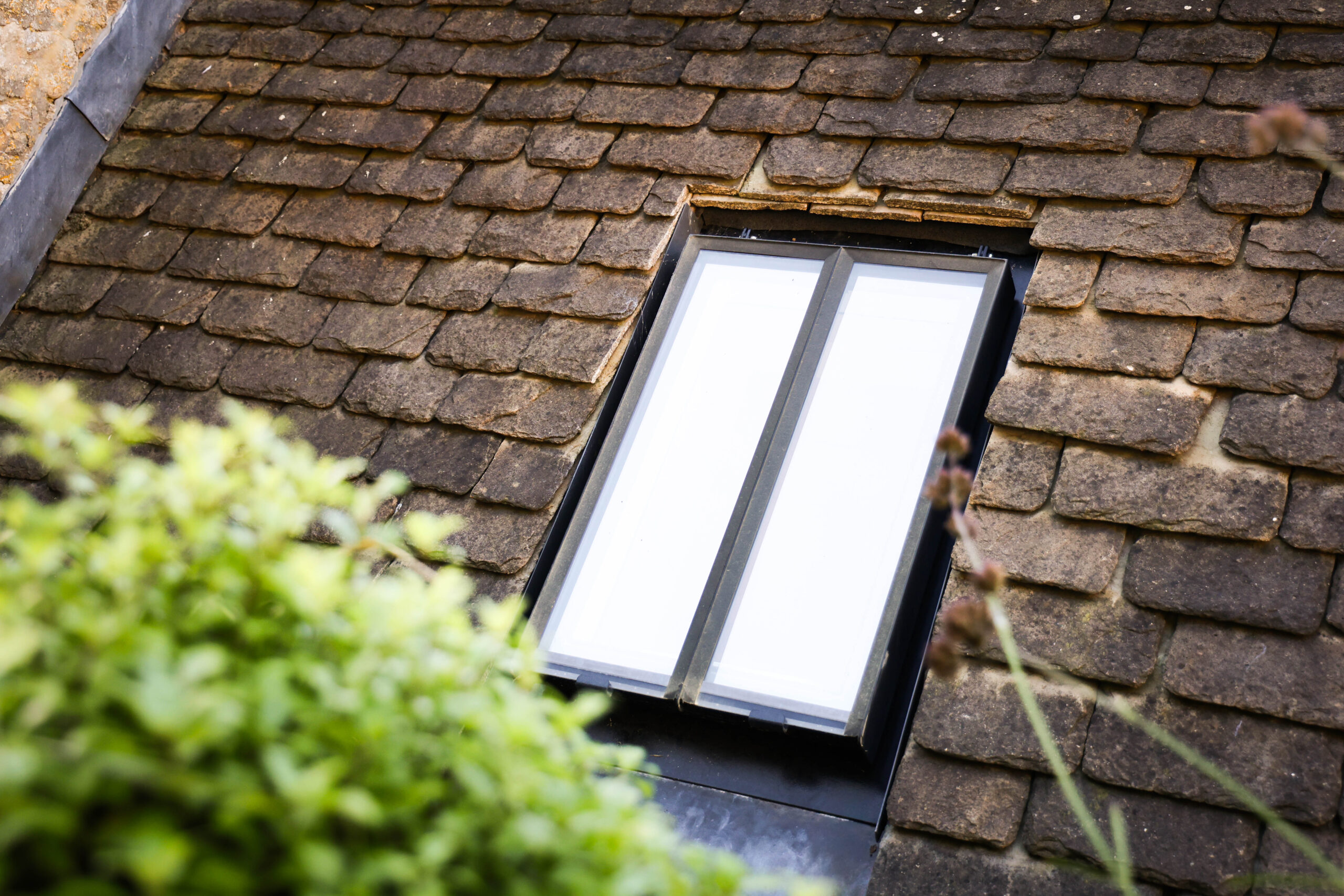
Our Conservation Rooflight is designed to fully comply to all conservation officer, English Heritage, and National Trust standards while maintaining a whole unit U-value of 1.4 W/m²K.
U-values and energy efficient rooflights
Building regulations ensure that U-values are low enough to provide sufficient insulation to a building. However, achieving U-values that are lower than the upper limit will ensure a more energy efficient rooflight. This is desirable for a number of reasons:
Naturally provides light and heat
Rooflights use the sun to naturally light and heat a room. However, if your rooflight has a higher U-value, it wouldn’t be able to retain that heat. A lower U-value will keep a room nice and warm, especially during the cold winter months.
A more comfortable living space
Having an energy efficient rooflight means that you will be reaching for the radiator and the air-conditioning less frequently throughout the year. The temperature will be much more stable and you will find yourself in a much more comfortable room.
Saves money
Installing energy efficient rooflights can mean you won’t need to rely as much on energy sources to warm your home, which over time can generate substantial savings on bills.
What are G-values?
G-values are different from U-values in that they measure the amount of solar transmittance that can enter through the glass of a rooflight. This is referred to as “solar heat gain”. G-values will often range between 0.2 and 0.7. Special coatings and glazing with a “solar control” can lower solar heat gain and achieve G-values of less than 0.5.
Why are G-values important?
Although a large amount of solar heat gain can be pleasant in the wintertime, it may make the summer months unbearably hot. G-values become increasingly important the larger the roof windows are. There is a bigger risk of over-heating and creating a greenhouse effect in a building with large amounts of glazing.
What is a good U-Value for a rooflight?
Good U-values for a rooflight will vary depending on budget, building regulations, and the type of building or room it will be installed into. For example, rooflights with triple glazing may have the lowest U-values, but they will also be heavier and more expensive. Gauge what is most important for your building. Double glazing is often sufficient for U-values that will ensure an energy efficient and sustainable building.
If you have any questions about what U-value is best for your building, get in touch. A friendly member of our experienced team will be happy to advise you.
Shop our full rooflight range today or head to our Instagram page for inspiration on your perfect rooflight.
Are There UK Tax Credits for Installing Rooflights?
While there are currently no specific tax credits or personal tax rebates available in the UK exclusively for installing rooflights or skylights, there are a number of financial benefits and broader energy-efficiency incentives that homeowners and businesses can take advantage of.
VAT Considerations
For most home improvement projects, including rooflight installation, the standard 20% VAT rate applies. However, some exceptions exist:
- A 5% VAT rate may apply if rooflights are installed as part of a qualifying renovation. This includes converting a building into a house or flats, or from one residential use to another. It also applies to refurbishing a property that has been unoccupied for two years or more immediately before the renovation work begins. Contractors typically need to provide HMRC with evidence of the unoccupied status.
- While some conversions of non-residential buildings into homes may qualify for 0% VAT under strict “new build” criteria, the 5% rate more commonly applies to large commercial conversions.
- Crucially, rooflights are not considered energy-saving materials for VAT purposes. Therefore, installing a rooflight alone will not qualify for reduced VAT unless part of a qualifying larger project.
- New-build homes are zero-rated for VAT. Rooflights installed during the construction of a new home are therefore not subject to VAT.
ECO4 & Council-Backed Retrofit Schemes
The Energy Company Obligation (ECO4) scheme, running until March 2026, requires energy suppliers to fund upgrades for low-income or vulnerable households. While the scheme focuses on insulation and heating, it can include window upgrades, such as replacing single glazing with double glazing. Rooflights may be included only if they significantly improve a home’s EPC rating and are part of a broader energy efficiency package.
There is no explicit mention of skylights in ECO4 funding guidance. However, councils may use ECO Flex to support other households in need, expanding eligibility but not necessarily the types of improvements covered.
Local Schemes and Grants
Local authorities and devolved governments operate additional programs:
- Scotland: Home Energy Scotland offers interest-free loans (up to £8,000) for energy-efficient glazing, but rooflights are not specifically mentioned and grant funding is not available for glazing.
- Wales: The Nest scheme focuses on heating systems, insulation, and solar panels. Rooflights are not listed among eligible improvements.
- Northern Ireland: The Affordable Warmth Scheme funds double glazing for eligible households. Rooflights are not explicitly mentioned but may be included at the discretion of the council.
Commercial Properties
Businesses can’t access grants specifically for rooflights, but they can benefit from Capital Allowances:
- Expenditure on thermal insulation, including double glazing and potentially energy-efficient rooflights, may qualify for Plant and Machinery Allowances (PMAs).
- Rooflights designed to reduce heat loss could be eligible for a 6% Writing Down Allowance.
- Rooflights are not eligible for 100% First-Year Allowances under the Energy Technology List (ETL), as they are not listed technologies.
- Some councils offer local energy grants that may cover rooflight upgrades, such as Falkirk Council’s Energy Efficiency Fund.
Bottom Line
There is no direct “rooflight grant” or specific tax credit in the UK, but installing energy-efficient skylights can still offer financial advantages:
- Long-term energy savings through improved insulation and natural lighting
- Potential VAT reductions in specific scenarios (e.g. new builds, qualifying renovations)
- Possible inclusion in broader energy-efficiency schemes (e.g. ECO4, local authority grants)
- Commercial tax relief through capital allowances for thermal insulation
Always check with your local authority or the Energy Saving Trust for the latest opportunities and eligibility criteria in your area.